
The Rider’s Library
Sixteen guides. Booking to the last climb.
The bike, the roads, and the country around them. Everything worth knowing before you land.
The Service and Your Bike
Before You Fly
The Riding
- The Algarve Climbs Worth Planning AroundYou are here
- How to Structure a Five-Day Training Block
- Portuguese Road Rules and Driver Etiquette
- Water, Heat and Where to Refill
The best climbs in the Algarve for road cyclists are Fóia, the highest point in the region at 902 metres, Alto do Malhão, the closing climb of the Volta ao Algarve, and the Wall of Alte. Fóia is the one everyone names and the longest, but at roughly 6-7% average from Monchique it is not the steepest. Malhão at 2.6 km averaging 9.8% is where riders get caught out. Here are the climbs worth building a week around, with what each actually asks of you.
Table of Contents
1. Fóia, from Monchique
Roughly 8 km at 6-7% average, summit 902 metres, ramps touching 10%.
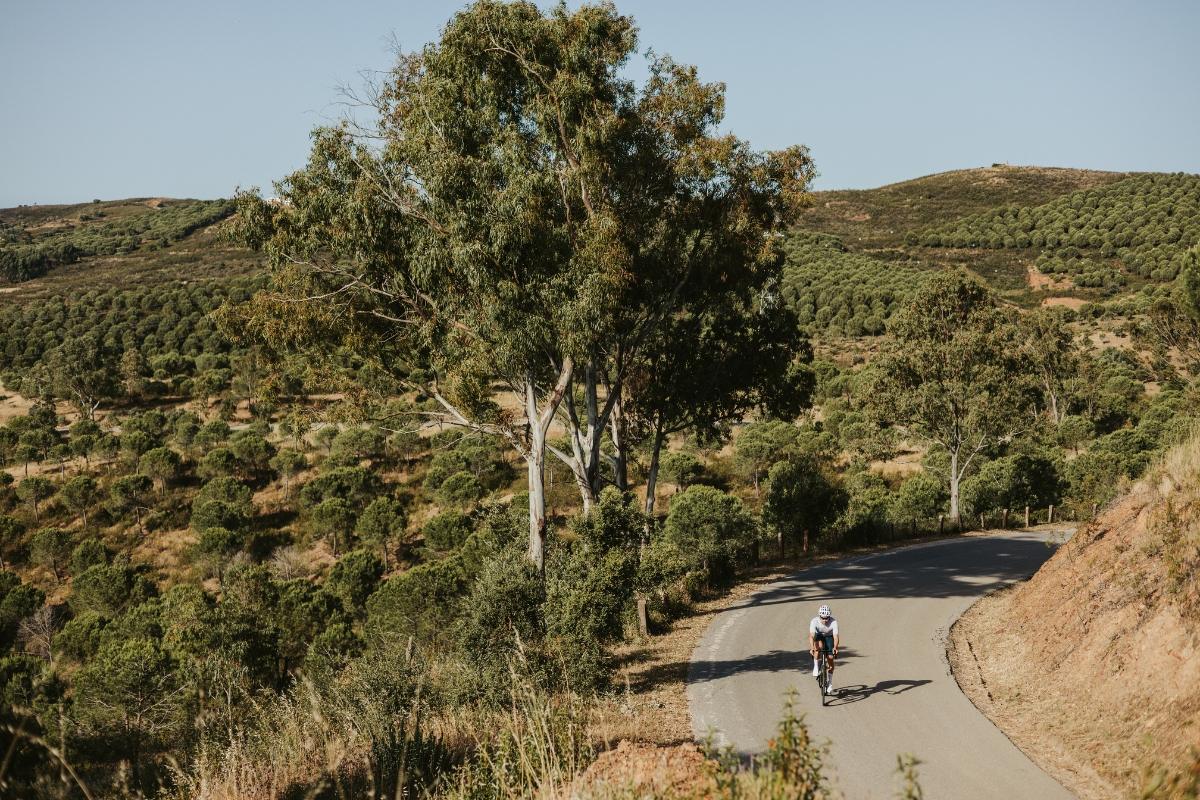
The Algarve’s high point and the climb that draws riders to the region. From Monchique village the road climbs steadily through eucalyptus and cork oak, opening out near the top with views to the coast on a clear day.
It is a long, honest, rhythm climb rather than a brutal one. The gradient sits in a range you can settle into, and the difficulty is the sustained twenty-five to forty minutes rather than any single ramp. Ramps near the summit touch 10% and the last two kilometres are the steepest part, which matters if you have gone out hard.
The approach matters as much as the climb. From Portimão it is about 25 km on the N266 to Monchique before the climb even begins, so a Portimão to Fóia round trip runs 75 to 80 km with well over 1,200 metres of climbing.
Gearing: a 34×30 or easier makes it a pleasure. Anything harder makes it work.
2. Alto do Malhão
2.6 km at 9.8% average.
The one riders underestimate, and the reason is the length. Under three kilometres reads as trivial on a route profile, and then the number next to it is nearly 10%.
This is the closing climb of the Volta ao Algarve, and it is the steepest regular ascent in the central Algarve. There is nowhere to recover on it. It sits north of Loulé in the hill country above the Barrocal, most commonly reached from Alte or from the Albufeira side.
If you ride one climb here at full effort, make it this one. It is short enough to properly empty yourself on and long enough for that to hurt.
Gearing: bring something easier than you think. A 34×32 is not excessive.
3. The Wall of Alte
2 km at 7.4% average.
Just beyond Alte village, and usually ridden as the warm-up act before Malhão. Named locally for good reason: it starts abruptly out of the valley and does not ease.
Alte itself is one of the prettier villages in the region and the natural coffee stop before the terrain turns serious. Take it, because there is nothing between there and the top of Malhão.
4. The Alferce Descent, Ridden Upward
The road down from Fóia through Alferce is the standard descent, which means most riders never climb it. Ridden the other way it is a longer, gentler ascent through a different valley on a quieter road, and it makes a good alternative approach when you want the Monchique altitude without the main road traffic.
It is the honest answer to the rider who has done Fóia twice and wants something new in the same area.
5. The Clifftop Rollers, Carvoeiro to Armação de Pêra
Not a climb, but it belongs here because it deceives people. The coastal lanes east of Carvoeiro drop into coves like Benagil and climb straight back out, repeatedly, with short pitches that are steeper than the profile suggests.
Riders treat this as a flat coastal spin and arrive at the end wondering where the day went. It is a useful tempo route precisely because of that repetition.
Which One Hurts Most
Fóia is the achievement. Malhão is the effort.
Fóia is longer, higher, and the one that goes in the photograph. But it is rideable at a steady tempo by anyone with reasonable fitness and sensible gearing. Malhão has no rhythm to find. At 9.8% for 2.6 km you are simply above threshold until it stops.
The mistake we see most often is a group planning Fóia as the hard day and treating Malhão as a filler because it looks short on paper. Reverse that assumption.
Planning a Week Around Them
Do not stack Fóia and Malhão on consecutive days. Both deserve fresh legs, and a week that includes each of them properly, with genuine recovery between, produces better riding than a week that includes both badly. Both also sit at the end of long stretches with no water, Monchique to the summit especially, so read where to refill water before either.
Structuring a five-day training block sets out how they fit into a week. For when to come, the Algarve month by month covers why March to May and September to October suit climbing far better than August. Every route here is loaded as GPX on the bikes we deliver, and the full set sits on our route pages.
Gradients and distances here are cross-checked against Strava segment data and route files, and re-verified at each review date. Segment figures vary slightly by where a given segment starts and ends, so treat these as accurate rather than absolute.
Frequently Asked Questions
What are the best climbs to ride in the Algarve?
Fóia is the highest at 902 metres, roughly 8 km at 6-7% from Monchique. Alto do Malhão is the steepest regular climb at 2.6 km averaging 9.8% and closes the Volta ao Algarve. The Wall of Alte, 2 km at 7.4%, usually precedes Malhão on the same ride.
How hard is the Fóia climb?
Long rather than steep. From Monchique it runs roughly 8 km averaging 6-7%, with ramps touching 10% in the final two kilometres and a summit at 902 metres. It rewards a steady tempo and sensible gearing more than raw power, and takes most riders twenty-five to forty minutes.
Which Algarve climb do riders underestimate?
Alto do Malhão. At 2.6 km it reads as trivial on a route profile, but it averages 9.8% with no recovery anywhere on it. Groups routinely plan Fóia as their hard day and treat Malhão as filler, then find the short one was the effort that hurt.
What gearing do I need for the Algarve climbs?
For Fóia, a 34×30 makes it enjoyable. For Malhão at 9.8%, a 34×32 is not excessive and most riders are glad of it. Our fleet runs SRAM Force AXS, and if you have a preference on cassette mention it when you book.
Can I ride Fóia and Malhão in the same week?
Yes, but not on consecutive days. Both deserve fresh legs, and they sit at opposite ends of the region, Fóia above Monchique in the west and Malhão in the central hills. Put a genuine recovery day between them and both rides are better for it.
Book Your Bike: check availability and book a bike here, with the routes loaded before you arrive.
No Comments