

The Rider’s Library
Sixteen guides. Booking to the last climb.
The bike, the roads, and the country around them. Everything worth knowing before you land.
The Service and Your Bike
- The Velo Algarve Experience: What a Week With Us Actually Looks Like
- What Is Included With Your Velo Algarve Bike
- Send Us Your Fit Numbers
- Understanding SRAM Force AXSYou are here
Before You Fly
The Riding
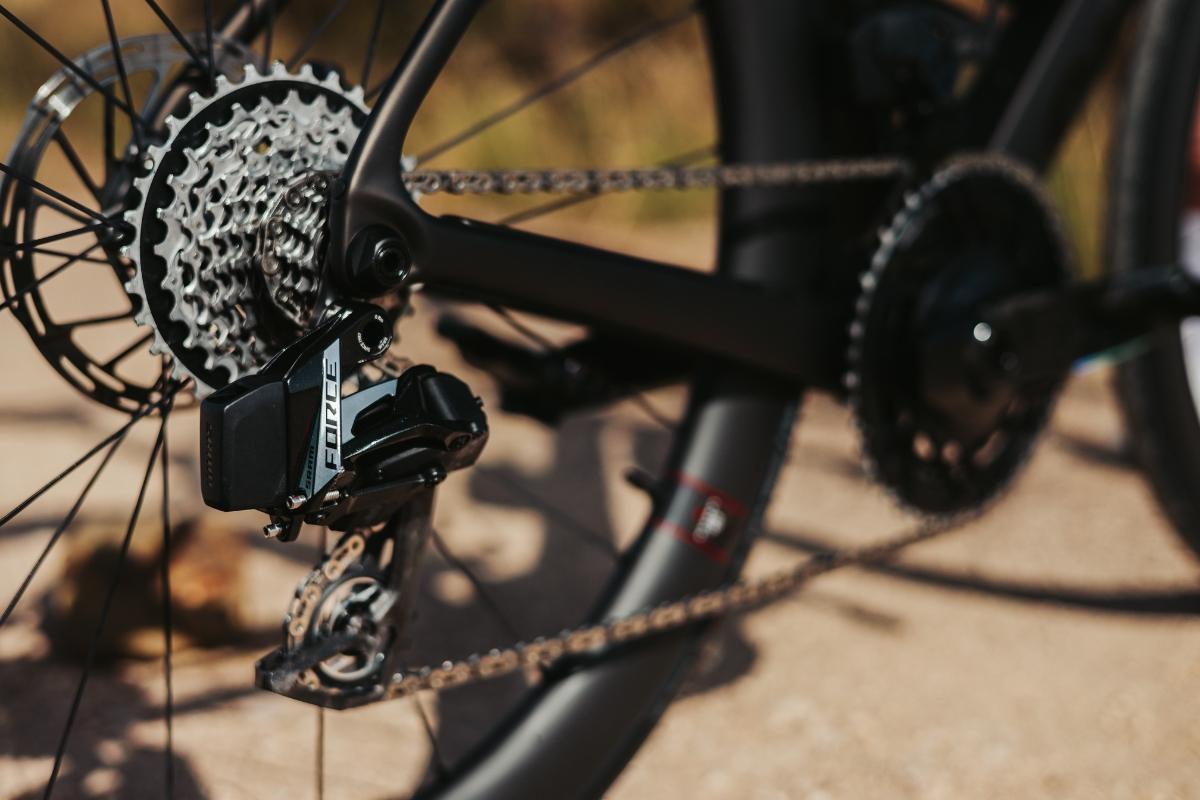
This SRAM Force AXS guide covers the one thing that catches out riders arriving from Shimano: the shift logic is not the same. On AXS, the right lever makes the gear harder and the left lever makes it easier. There are no up and down paddles on each side. We set every bike in the fleet to sequential mode, which means the system handles the front derailleur for you, and you can still shift it yourself by pressing both levers together.
Table of Contents
How the Shifting Works
SRAM calls it eTap logic, and it is deliberately minimal. One button behind each lever, and only two things to remember:
- Right lever: harder. The chain moves to a smaller sprocket.
- Left lever: easier. The chain moves to a larger sprocket.
Harder on the right, easier on the left. Hold either lever down for multiple shifts.
The mistake Shimano riders make on day one is instinctively reaching for a second paddle behind the brake lever that does not exist, then pressing the wrong side under pressure at the bottom of a climb. It takes about twenty minutes of riding to unlearn. The Algarve’s flatter coastal roads are a better place to do that than the first ramp on the N266 to Monchique.
We Set the Fleet to Sequential Mode
Every bike goes out in sequential shifting, one of SRAM’s enhanced shift modes, configured in the AXS app before delivery. It is worth understanding, because it changes what those two levers actually do.
In sequential mode the drivetrain behaves as a single ladder of gears rather than two chainrings you manage separately. Press the right lever and you get the next hardest gear ratio. Press the left and you get the next easiest. When the next ratio in that sequence sits on the other chainring, the system shifts the front derailleur itself and moves the rear derailleur at the same time to compensate, so the jump in cadence stays small and consistent.
What that means in practice on a climb like Fóia: you keep pressing the left lever and the gears keep getting easier. You do not have to decide when to drop to the small ring, or think about where the chain will land on the cassette afterwards. It happens, and the cadence change is smaller than a manual front shift would give you.
It also removes the overlapping ratios. On a 2x drivetrain a good number of gear combinations duplicate ratios you already have. Sequential skips those, so every press gives you a different gear.
We enter the correct cassette size in the AXS app for each bike, which is what lets the system pick the right shift points. It is a small thing that gets missed on plenty of rental bikes and makes the mode noticeably better when it is done.
Shifting the Front Derailleur Yourself
Sequential handles the front for you, but it does not lock you out of it. Press both levers at the same time and the front derailleur shifts to the other chainring, exactly as it would in full manual mode.
That matters in two situations. The first is a climb you can see coming, where you would rather drop to the small ring before the gradient hits than have the system do it mid-effort. The second is a long descent or a fast flat section where you want the big ring and intend to stay in it.
The action itself is a single deliberate press of both levers together, not a rapid double tap. If nothing happens, you have most likely pressed one a fraction before the other and the system has read it as a rear shift.
One quirk of any 2x AXS drivetrain: the small chainring with the smallest cog is locked out by design, to keep the chain from rubbing the inside of the big ring. If you are in the small ring and the rear stops going harder before the smallest sprocket, that is by design, not a fault. Shift to the big ring and it continues.
If you would rather ride full manual, it takes ten seconds in the AXS app to turn sequential off. Tell your concierge and we will set it back before the next rental.
Battery Life and What the Lights Mean
The system is fully wireless. Each derailleur carries its own removable rechargeable battery, and each shifter runs a CR2032 coin cell.
SRAM rates the derailleur batteries at roughly 60 riding hours per charge, and they take about an hour to charge from flat. In practice that comfortably covers a week of holiday riding, and every bike leaves our workshop with both derailleur batteries checked rather than assumed. The shifter coin cells last about two years at fifteen hours of riding a week.
An LED on each component flashes when you shift, and the colour tells you where you are:
- Green: more than 25% remaining.
- Red: between 10% and 25%.
- Flashing red: under 10%.
The detail that matters is that shifting performance does not degrade as the battery drops. There is no sluggishness to warn you, no hesitation building over a few days. It works exactly the same right up until it stops, which is why the LED is the only warning you get and why we check both derailleurs before every delivery rather than relying on the last rider to mention it.
If a Battery Dies Mid-Ride
Two things happen, both survivable.
The derailleur stays in whatever gear it was in when the battery died. You do not lose the chain or get dropped into the smallest sprocket. If the rear goes while you are in a sensible gear, you can ride home on a single-speed rear and a working front.
And the batteries are interchangeable. The front and rear derailleurs use identical batteries, so you can pull the front derailleur battery, fit it to the rear, and carry on with whichever chainring you happen to be in. Rear shifting matters far more than front shifting for getting home.
Every bike in the fleet also carries a spare AXS battery in the saddle bag, which makes this largely theoretical. Swapping one takes seconds: unclip the latch, pull the battery, fit the spare, close the latch.
The AXS App
The SRAM AXS app pairs directly with the groupset from an Android or Apple phone, with no extra hardware. It shows exact battery percentages for each component rather than the three-colour LED, which is useful if you want certainty before a long day.
It also lets you change the shift mode and reassign what the buttons do. We set the fleet to sequential with the correct cassette entered for each bike, but you are welcome to pair your phone and switch to full manual for your rental. We would rather you did that than fight a setup you dislike all week. Tell your concierge so we can set it back afterwards.
Two Quirks Worth Knowing
The system sleeps when the bike is stationary, to save power. If you press a lever and nothing happens after the bike has been parked for a while, shake or bounce the bike, or just start pedalling, and it wakes up. That is normal behaviour and not a fault.
Battery drain is also higher in hilly terrain than on the flat, because the rear derailleur is doing more work. A week built around Fóia and the Monchique climbs will use more charge than a week of coastal riding out of Lagos. It is not enough to run a fresh battery flat in a week, but it is why we check rather than assume.
What We Do About It
Every bike is checked before it goes out: battery level on both derailleurs read directly rather than guessed, every gear shifted through by hand to confirm clean indexing, and any hesitation re-indexed before the bike is loaded. Firmware is updated monthly at the workshop, never on the morning of a delivery.
If shifting misbehaves during your rental, message your concierge before doing anything else. Most of it is diagnosable over the phone in a couple of minutes, and if a battery has died we bring a replacement to you. The spare battery is part of the standard kit listed in what is included with your bike, and the shifting walkthrough at handover is one stage of what a week with us looks like.
Frequently Asked Questions
How does SRAM Force AXS shifting work?
The right lever gives you a harder gear, the left lever an easier one. There is one button behind each lever rather than two paddles per side, which is the main difference from Shimano. Our bikes run sequential mode, so the front derailleur shifts itself when the next gear in the sequence needs it.
How long does a SRAM Force AXS battery last?
SRAM rates the derailleur batteries at roughly 60 riding hours per charge, and a flat battery recharges in about an hour. The shifter coin cells last around two years. Shifting performance stays identical as charge drops, so the LED indicator is your only warning.
What happens if the battery dies mid-ride?
The derailleur stays in the gear it was already in, so you keep riding. Front and rear batteries are identical, so you can move the front derailleur battery to the rear and carry on. Every Velo Algarve bike also carries a spare AXS battery in the saddle bag.
Why is my AXS not responding?
Most likely it is asleep. The system powers down when the bike is stationary to save battery. Shake or bounce the bike, or start pedalling, and it wakes up within a second or two. If the LED shows flashing red, the battery is low and needs swapping.
How do I shift the front derailleur myself?
Press both levers at the same time. Sequential mode manages the front derailleur for you, but a deliberate simultaneous press still shifts it manually, which is useful for dropping to the small ring before a climb rather than mid-effort. Press one lever a fraction early and the system reads it as a rear shift instead.
Book Your Bike: check availability and book a bike here.
No Comments