
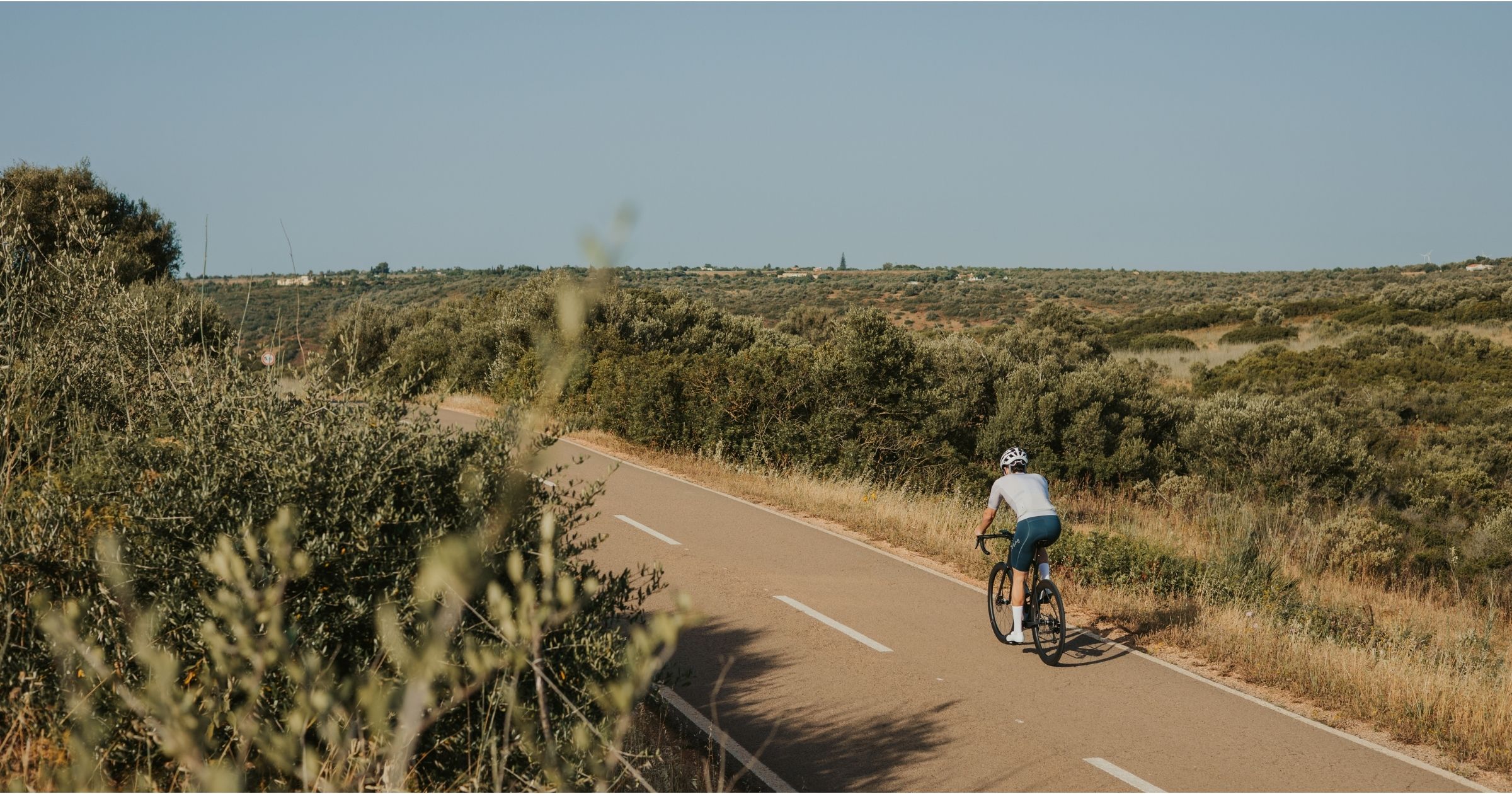
Cycling the Barrocal above Tavira in the Algarve means riding the limestone belt between the coast and the Serra do Caldeirão: citrus and almond groves around Santa Catarina da Fonte do Bispo, short steep climbs like Cerro de São Miguel (3.6 km at 8.7%), and long stretches where a tractor counts as traffic. Loops from Tavira run from 62 km and 575 m up to 136 km and 2,400 m. Ride it February to May or September to November, carry two full bottles, and plan your coffee for the finish in Tavira.
Most visiting riders base themselves west of Faro and never come this far east. That suits the people who ride here. The roads north of Tavira clear of traffic within about 5 km of town, and the barrocal proper starts above Fonte do Bispo.
Key Takeaways
- The Barrocal is the limestone belt between the Algarve coast and the serra. Its hills rarely top 400 m, so the riding is rolling, with repeated climbs of 1 to 4 km.
- Cerro de São Miguel above Moncarapacho is the signature barrocal climb: 3.6 km, 313 m of climbing, 8.7% average, steepest section 12%.
- Alcaria do Cume, north of Santa Catarina da Fonte do Bispo, takes you above 500 m where the barrocal meets the Serra do Caldeirão.
- The Tavira Granfondo course is one of the hardest days in the Algarve: about 136 km with close to 2,400 m of climbing, and nearly a third of it in the first 30 km.
- Cafés are scarce between Tavira and the hills. Take water at any open shop and save the coffee for The Table or Xisto in Tavira.
- Best months are February to May and September to November. The pros agree: the Volta ao Algarve finished its opening stage in Tavira in February 2026.
What Is the Barrocal?
The Algarve splits into three belts running east to west: the litoral along the coast, the serra along the northern border with the Alentejo, and the barrocal in between. Geographers have used that division since Bonnet’s survey of 1850. The barrocal is Jurassic limestone and red clay soil, farmed for oranges, almonds, figs, olives and carob. Its hills rarely rise above 400 m, and the highest point in the whole belt, Rocha da Pena near Salir, stands at 479 m.
For a road cyclist, that geology decides the day. The limestone ridges run east to west, so any road heading north out of Tavira crosses them one after another. You get repeated climbs of 1 to 4 km rather than one long ascent, and short descents between them that never quite let the legs settle. It rides like a set of intervals the terrain has written for you, which is why it suits a training block.
Push far enough north and the limestone gives way to the older hills of the Serra do Caldeirão. That is where the longer climbs start, and where the routes below go when they want a bigger day.
Barrocal Cycling Routes From Tavira
Into the Limestone Hills – 62 km, 575 m
Our easiest eastern day heads north from Tavira through the citrus groves of Santa Catarina da Fonte do Bispo and climbs into the limestone hills above São Brás de Alportel, then loops back to Tavira on different roads. The climbing is spread across rolling terrain rather than stacked on one summit, which makes it the right first ride after a flight. We tell every rider the same thing: ease into the week rather than making day one the hardest. Full stats and the GPX file are on the Into the Limestone Hills route page.
Cerro de São Miguel – The Barrocal’s Signature Climb
Cerro de São Miguel, also known as Monte Figo, is the 410 m summit above Moncarapacho, between Tavira and Olhão. From Moncarapacho, Climbfinder measures the climb at 3.6 km with 313 m of climbing, an average of 8.7% and a steepest section of 12%. That puts it in the third category. At a steady 11 km/h it takes about 20 minutes. At 15 km/h it is just over 14.
The upper road is rough in places, with broken tarmac and old surface, so pick a line early and stay seated. At the top are radio masts, a large swing and a view across the Ria Formosa lagoon to the sea. São Miguel is the centrepiece of The Cobbled Ascent, our 70 km, 1,300 m eastern route and the hard day of the three.
Alcaria do Cume – Where the Barrocal Meets the Serra
North of Santa Catarina da Fonte do Bispo the orange groves thin out and the road heads for Alcaria do Cume, a summit just over 500 m on the southern edge of the Serra do Caldeirão, in the parish of Cachopo. Before you get there, the climb through Bemparece throws in some very steep ramps. The last kilometre to the top is gentler on average, 1.1 km at 5.1% with a maximum of 13.4%, but it kicks.
On a clear day you can see the Atlantic from the top. From here it is mostly downhill back to Tavira or, if you want the full day, north and east toward Alcoutim and the Guadiana on The Border Road, 105 km and 1,650 m on the most remote roads we ride.
The Tavira Granfondo Course: Why It Is So Hard
The seventh Tavira Granfondo ran on 27 September 2026, organised by three local clubs, União Ciclismo Tavirense, Clube Bike Team Tavira and Núcleo Cicloturismo Luz Tavira. The official event offered a granfondo of about 135 km and a mediofondo of about 80 km, starting and finishing in Tavira. I rode the long route this year. It is a very difficult course, and the profile shows why. These figures come from my GPS file of the course.
- Full route: 136 km and 2,376 m of climbing, about 17.5 m of climbing for every kilometre
- Tavira to the first feed zone: 30.5 km and 759 m of climbing
- Fonte Salgada to Umbrias de Camacho: 9.2 km and 397 m at about 4.3% average, the longest climb of the day
- The middle of the day: north-east to Alcoutim on the Guadiana, then back south past Foz de Odeleite and Azinhal on roads that never stay flat for long
For comparison, Into the Limestone Hills climbs about 9 m per kilometre. The Granfondo is close to double that, over more than twice the distance. Nearly a third of the climbing comes in the opening 30 km: the roads leave Tavira and go straight up through the barrocal, so the first hour decides how the rest of the day goes. Riders who chase wheels out of town pay for it on the Guadiana. The Umbrias de Camacho climb is long and even rather than steep, so ride it to a power or heart-rate target, not to the group around you. If the Granfondo is on your calendar, ride Into the Limestone Hills and The Cobbled Ascent in the days before and you will have seen most of the opening roads.
Road Surfaces, Traffic and Dogs
The N270 north from Tavira toward São Brás de Alportel is smooth and well maintained. The side roads into the barrocal hills are narrower but in good condition, and traffic is light outside the school run. You can ride long stretches without a car passing in either direction.
The trade-off for roads this quiet is dogs. Farms and rural houses line the back roads, and dogs that are not used to cyclists do come out. Slow down when you see one ahead, avoid sudden movements and do not sprint past. Almost every encounter ends with nothing more than noise.
Cafés and Water: Plan the Stop Before You Need It
The eastern interior is less populated than the west, and services in the barrocal villages are infrequent. Treat any open shop or bar as a water stop, even if you think you have enough. On a 60 to 70 km loop, two full bottles is the minimum. In late spring, plan a refill as well.
The coffee stop that matters is at the end. The Table and Xisto in Tavira are the two specialty coffee stops we send riders to after an eastern loop.
Best Time of Year to Ride the Barrocal
February to May and September to November. In February, Tavira averages a daytime high of around 17°C and a low of around 9°C, and March pushes the high toward 19°C. The citrus is on the trees in late winter and spring, which is when the groves around Santa Catarina are at their best.
The professionals use the same window. Stage 1 of the 2026 Volta ao Algarve ran 185.6 km from Vila Real de Santo António to Tavira on 18 February, with 2,359 m of climbing. In July and August the interior heats up early in the morning. Start at first light and be back in Tavira before midday.
A Race-Ready Bike Delivered to Tavira
Velo Algarve is delivery-only. We bring a Cervélo Soloist with SRAM Force AXS and a power meter to your hotel, villa or apartment, fit it to you on the spot after a pre-delivery fit call, and collect it from the door when you leave. Frames come in 51, 54, 56 and 58 for riders of roughly 158 to 194 cm, and the fleet is replaced every season. The power meter earns its place out here. On terrain this broken up, riding to watts is how you stop a string of short climbs turning an endurance day into something harder.
Every rental includes pedals fitted (Look Keo or Shimano SPD-SL), a saddle bag with a spare TPU tube, multitool, spare AXS battery and a mini electric pump, one bottle, one gel, our curated GPX route files and WhatsApp support. A Garmin with the routes loaded is a €12 a day add-on, and you bring your own shoes. Rates start at €109 a day on the 3-day minimum and drop for longer rentals; current pricing and rental periods are on one page. Delivery is priced by distance from Lagos and shown at checkout. In peak season, book two to three months ahead. More on bike rental in Tavira.
Frequently Asked Questions
What do you need to know about cycling the Barrocal above Tavira before you go?
The Barrocal is rolling limestone country with short, steep climbs, quiet roads and very few cafés. Loops from Tavira run from 62 to 136 km with 575 to 2,400 m of climbing. Carry two full bottles, take water at any open shop, watch for farm dogs on the back roads, and ride between February and May or September and November.
How hard is the Cerro de São Miguel climb?
Cerro de São Miguel is a third-category climb. From Moncarapacho it is 3.6 km with 313 m of climbing at an average of 8.7%, and the steepest section reaches 12%. At 11 km/h it takes about 20 minutes. The upper road is rough in places, so stay seated, pick your line early and save something for the final ramps.
Is the Barrocal above Tavira good for a winter training camp?
Yes. The Barrocal gives repeated climbs of 1 to 4 km on quiet roads, which suits structured efforts, and February highs of around 17°C make long days realistic. From one base in Tavira a group gets three distinct days: Into the Limestone Hills, The Cobbled Ascent over São Miguel, and The Border Road to Alcoutim.
Can I rent a road bike delivered to Tavira?
Yes. Velo Algarve delivers a pre-fitted Cervélo Soloist with SRAM Force AXS and a power meter to accommodation in Tavira and anywhere in the Algarve as far as the Spanish border. Rentals start at three days, the bike is fitted at delivery, and we collect it from your door. In peak season, book two to three months ahead.
How hard is the Tavira Granfondo course?
Very hard. The long route covers about 136 km with close to 2,400 m of climbing, around 17.5 m per kilometre. Nearly a third of that comes in the first 30 km out of Tavira, and the longest climb, Fonte Salgada to Umbrias de Camacho, runs 9.2 km at about 4.3%. Pace the first hour carefully.
Ride the Inland Roads
If the barrocal is on your list for this spring, check dates and book a bike here. We will have it fitted and waiting for you in Tavira.
No Comments