
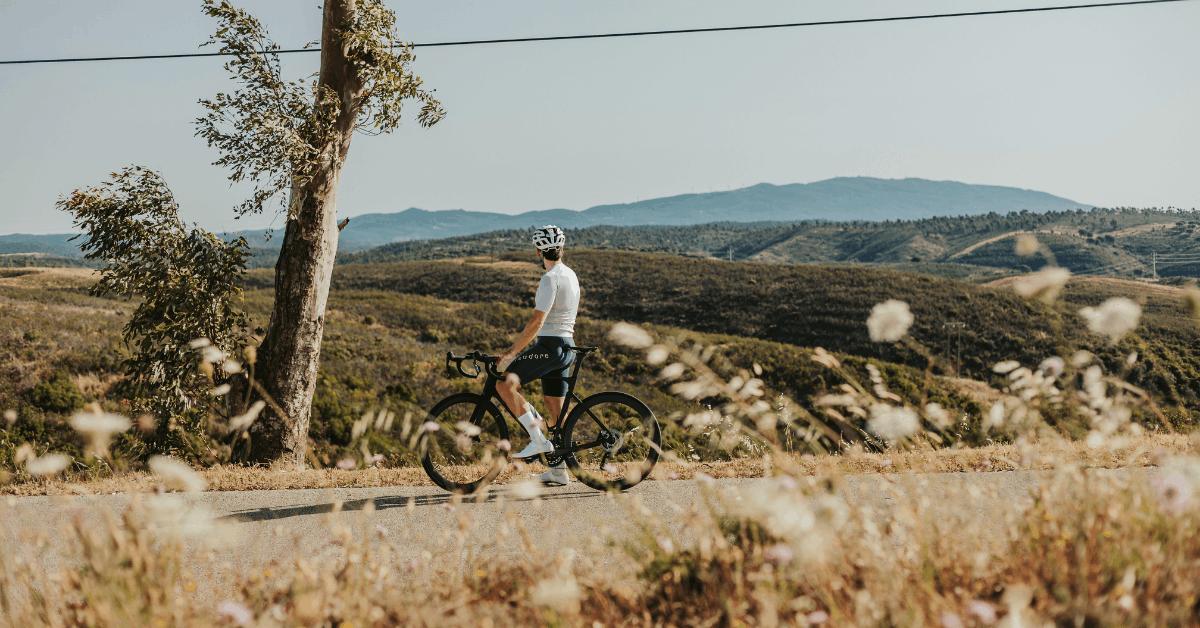
Portugal does not need an introduction for cyclists in the know. The Volta ao Algarve is a UCI ProSeries race that Jonas Vingegaard won in 2025 and where Remco Evenepoel, Primoz Roglič and Tadej Pogačar have all sharpened their early-season legs. Riders from the UK, Netherlands, Germany, Belgium and Scandinavia have been heading south in February and March for years, drawn by the same things: reliable winter sun, low traffic, long climbs and smooth roads through the orange groves and eucalyptus forests of southern Portugal.
This is not a destination that needs to be sold to cyclists. What it needs is an honest, specific account of what cycling holidays in Portugal actually look like on the road – where to ride, when to go, what to expect from the terrain, and how to make the most of your week on the bike.
Key Takeaways
- The Algarve is a year-round cycling destination with around 300 days of sunshine – there is no bad month to come
- February to April is the peak training bloc window: quiet roads, mid-teens to low-twenties temperatures, and the Volta ao Algarve running on the same roads you will be riding
- Foia (902m) is the defining climb – approximately 8km at 7.3% average from Monchique, or 16km from Caldas de Monchique – with around 2,000m of elevation for a full day from the coast
- The Algarve offers quieter roads, comparable costs and genuine route variety that makes it a strong alternative to Mallorca for a winter training camp
- Self-guided cycling holidays in Portugal work well in the Algarve – the main logistical decision is whether to fly your own bike or rent on arrival
Why Portugal for a Cycling Holiday
The Algarve sits at roughly the same latitude as Lisbon and the southern coast of Spain. In February, when most of Northern Europe is cold, grey and offering very little outside of the turbo trainer, the Algarve is returning daytime highs of around 16-18 degrees Celsius. By March, that climbs to 18-21 degrees with an average of seven hours of sunshine per day. The roads are quiet. The coffee is strong. The gradients are honest.
It is also worth saying what a cycling holiday in Portugal is not. It is not a beach resort with bikes thrown in. The roads in the Serra de Monchique west of Lagos are used by WorldTour teams as pre-season training ground for a reason. The climbs are real, the descents reward attention, and the terrain through the Barrocal limestone belt east of Silves offers route variety that takes weeks to get through properly.
The Algarve is one of the sunniest regions in Europe, with around 3,000 hours of sunshine per year. That is not a marketing statistic – it means you can ride here in every month of the year. The roads are usable in January when the UK is frozen, in June when the light lasts until nine in the evening, and in October when the summer crowds have gone and the days are still warm into the afternoon. The question is not whether you can ride – you can. The question is what kind of riding suits the month you are coming.
The Terrain: What Portuguese Roads Actually Ride Like
Coastal and Rolling – West Algarve
The coast road west of Lagos out towards Sagres is long, relatively flat, and mostly sheltered from the worst of the Atlantic wind when you stay slightly inland. From Lagos to Sagres is around 35km each way, which gives you a workable base ride before adding climbing. The roads through Luz, Burgau and Salema have good surface quality year-round and the traffic is light enough to ride confidently in any season.
This is where riders staying near Lagos or Portimão tend to start. It is accessible, the cafe options are reliable, and you can build a 90-100km loop without putting yourself into serious mountain territory. Good for day one of a training camp when you are still adjusting to the time zone and getting the legs turning.
The Climb Everyone Does – Foia and the Serra de Monchique
Foia is the highest point in the Algarve at 902 metres. From the town of Monchique the climb runs for approximately 8km at an average gradient of 7.3%. From Caldas de Monchique the full version extends to around 16km with 795 metres of vertical gain. The Volta ao Algarve uses it as a summit finish nearly every year – in 2025 Jan Christen won at the top, with João Almeida and Roglic in the group behind him.
Most riders approach from the coast, either from Lagos or Portimão, which means adding a further 25-30km and several hundred metres of climbing before the main event. A full day from Lagos to Foia summit and back is a proper training ride: around 100-110km with 2,000 metres of elevation depending on the exact route. Enough to build form without destroying it.
The road surface through the eucalyptus and cork oak forest above Monchique is manageable. The descent back requires focus – there are tight bends and the odd patch of poor surface – but it is not a road that punishes careful riders. Give it the respect it deserves and the return is one of the better descents available in the western Algarve.
Inland – Silves, the Barrocal, and East Algarve
East of Portimão the terrain shifts. The Barrocal – the limestone belt running inland from the coast between Silves and Tavira – produces a different kind of riding. The roads through Alte, Salir and the hills above Loulé are quieter than the coast-adjacent routes, with steady rollers rather than sustained climbs. Good for accumulating elevation over distance without committing to a full mountain day.
Further east, the roads around Tavira and into the Serra do Caldeirão offer a different character entirely. Lower traffic, older villages, and a landscape that feels genuinely away from the tourist belt. Riders who stay in the eastern Algarve around Tavira or Vila Real de Santo António have access to routes that most cycling visitors to the region never touch.
When to Book a Cycling Holiday in Portugal
The honest answer is: any time. The Algarve has around 300 days of sunshine per year. There is no month where riding is off the table. What changes across the year is the character of the riding – the temperature, the volume you can sensibly put in, and what you want to do when you get off the bike.
February and March – The Training Bloc Window
February and March are the peak months for riders who want consistent high-volume days. The Volta ao Algarve runs in mid-to-late February, which brings professional teams to the region and gives the roads a particular energy. Temperatures are reliably in the mid-teens to low twenties during the day. Rain is possible but not dominant – the Algarve receives significantly less winter rainfall than the UK, and even a slower weather week in February here will likely give you four or five strong riding days out of seven.
Groups booking in this window are generally after consistent training days. Six to eight riders, 80-130km a day, 1,500-2,500 metres of elevation per ride. The accommodation is quieter and the roads even more so. For a structured training bloc, this is the window.
April and May – Long Days and Open Roads
April and May bring warmer days and longer light. The orange groves around Silves and the green of the Serra de Monchique are at their best. Temperatures are climbing towards the mid-twenties and the days are long enough for ambitious routes without a first-light start. This is a strong window for riders who want quality riding without the full training camp structure – groups who want to ride well and eat well in equal measure.
June – The Sweet Spot Before Summer
June is underrated. The temperatures are warm but not yet at their peak, the roads are still manageable at almost any time of day, and the evenings are long enough to eat outside in a t-shirt after a 120km day. Riders who want near-perfect conditions without the February cold and without the full heat of high summer should look seriously at June. It is one of the best months on the Algarve roads.
July and August – Ride Early, Own the Day
Summer in the Algarve is warm and the days are long. Highs of 28-32 degrees are normal in July. The approach that works is a simple one: start at 7am, ride 50-80km, be back at the villa or the hotel by midday. You have beaten the heat, you have a good ride in the legs, and you have the rest of the day – the pool, the beach, lunch somewhere decent – ahead of you. For groups combining a cycling holiday with a family trip, or couples where one partner rides and one does not, this structure works perfectly.
Riders staying near Quinta do Lago, Vale do Lobo or Vilamoura in summer are well placed for this kind of morning ride. The roads north towards Loulé and Salir cool quickly with altitude and give motivated riders proper climbing options even in high summer. The Algarve in July and August rewards the early riser.
September, October and November – The Autumn Window
September through November is the second major peak for cycling holidays in Portugal. The temperatures drop back into the low-to-mid twenties, the summer visitors thin out, and the roads take on a different quality. The light in the Algarve in October is genuinely unlike anywhere else in Europe. Riders planning around events tend to target this window – Ironman Portugal, autumn gran fondos, and the final weeks of warm, long-day riding before winter. Good weather is highly reliable right through to the end of November.
December and January – Winter Riding That Makes Northern Europeans Jealous
December and January are the coolest months in the Algarve, with daytime highs of around 16-18 degrees. That is still entirely rideable in a base layer and arm warmers – and when you message your riding group back home to tell them what the temperature is, the response is predictable. The roads are at their absolute quietest. Foia in January with no traffic and clear air at the summit is one of the better experiences available anywhere in European cycling. Accommodation rates are at their lowest. For riders who want to bank kilometres in proper conditions while everyone else is on the turbo, this is the window.
Self-Guided Cycling Holidays in Portugal – What That Actually Means in the Algarve
The term self-guided cycling holiday gets used loosely. At one end it means a tour company hands you maps and a phone number. At the other end it means turning up to the Algarve with a GPS unit and working it out yourself. Most serious riders are somewhere in between: they want the freedom to set their own pace and route, but they do not want to spend half their holiday planning logistics.
The Algarve makes self-guided riding very practical. Faro airport has direct connections from most Northern European cities. The road network is navigable with a quality GPS and pre-loaded GPX routes. Cafes are reliably spaced in the west and central Algarve. Mobile signal holds through most routes. You are not riding into genuinely remote territory.
Where riders run into problems is on the bike itself. Flying with a bike is manageable if you do it regularly, but it adds cost, airport stress and the risk of arriving with a damaged component the day before a big ride. For groups of four or more the maths often tips towards renting – particularly when the rental quality is there.
That is where Velo Algarve fits into a self-guided cycling holiday in Portugal. A carbon road bike – including the flagship Cervélo Soloist – delivered to your accommodation with a pre-loaded Garmin, a stocked saddle bag and an on-site bike fitting. No shop queue. No transport. Your bike is ready when you get there. For a group of six organising a training week around Lagos or Portimão, it removes the single biggest logistical headache of the trip. Take a look at how the delivery process works before you commit to flying your own.
What the Algarve Does Better Than Mallorca
Mallorca is the default for Northern European cycling camps and it deserves its reputation. But the comparison with a cycling holiday in Portugal is worth making honestly, because the Algarve offers things Mallorca does not.
Roads. The Algarve west of Faro has road traffic that Mallorca simply cannot match for quiet. In February and March the roads around Monchique and the Serra do Caldeirão are close to empty. No tour buses, no rental cars doing 10km/h past the viewpoints. On Mallorca in spring you share the cols with several hundred other cyclists. In the Algarve you often do not.
Cost. Flights from the UK and Northern Europe to Faro are competitive with Palma across most of the year. Accommodation in the Algarve in winter and shoulder season is often meaningfully cheaper than Mallorca, and even in summer the villa market offers strong value for groups. Group villas with private pools are available at a price point that makes the week financially sensible rather than aspirational.
Originality. The Algarve is not yet saturated with cycling tourism the way Mallorca is. The road from Lagos inland to Monchique is not lined with cyclists in matching kit. That will change. But right now, a mainland Portugal cycling holiday still has the quality of roads and weather with a fraction of the cycling traffic.
Cycling Events in the Algarve
Volta ao Algarve
The Volta ao Algarve is a UCI ProSeries race run every February. The 2026 edition ran from 18-22 February with 13 UCI WorldTeams in the start list, including INEOS Grenadiers, Red Bull-Bora-Hansgrohe and UAE Team Emirates. Filippo Ganna won the individual time trial stage. Juan Ayuso took overall honours. The race uses the roads riders train on – Portimão to Lagos, Lagoa to Alto da Foia, Vila Real de Santo António to Tavira. Riding those roads in the days around the race, knowing the parcours, adds something to the experience that no amount of Strava segments can replicate.
Algarve Gran Fondo
The Algarve Gran Fondo runs alongside the Volta ao Algarve in February. The 2026 edition started in Lagos on 21 February with two routes: approximately 130km (around 2,000 metres of elevation) and 90km. The event is timed electronically and open to both licensed and non-licensed cyclists. For riders coming to the Algarve specifically for an event, this is the one that combines competitive structure with the experience of riding the same roads as the professionals. Check the official Algarve Cycling Association site at acalgarve.pt for current registration details.
Planning a Cycling Holiday in the Algarve – Practical Logistics
Getting There
Faro airport is the gateway for the Algarve and has direct flights from London Gatwick, London Stansted, Amsterdam, Brussels, Dusseldorf, Copenhagen and other Northern European cities. Ryanair, easyJet and TAP all operate routes depending on the season. Transfer times from Faro to Lagos are around 45-60 minutes by car or taxi. Portimão is around 50 minutes. Tavira is around 30 minutes east of Faro.
Where to Base Yourself
Lagos is the most practical base for riders targeting the Serra de Monchique and the west Algarve. It sits at the junction of the coastal and mountain routes and has good cafes, supermarkets and accommodation options at all price points. Group villas within 10-15km of Lagos put you directly into the best riding terrain.
Portimão works well for groups wanting quick access to both the F1 circuit loop and the Monchique road. Vilamoura and the resort zone around Quinta do Lago and Vale do Lobo suit riders who are doing the cycling holiday as part of a broader family or group trip. The terrain is flatter and the routes shorter, but the roads to the north towards Loulé and Salir give motivated riders options for longer days.
Velo Algarve delivers across the whole Algarve – Lagos, Portimão, Vilamoura, Faro, Tavira and everywhere in between. The full list of delivery areas is at veloalgarve.com/delivery.
What to Pack
February and March mean kit for a range of conditions. Arm warmers, a gilet and a lightweight waterproof are required. By mid-April you can leave the heavy jacket at home but mornings can still be cool. Descending Foia in February with the wind up warrants an extra layer regardless of the temperature at the bottom. Shorts and a base layer will cover most days from March onwards.
If you are renting from Velo Algarve, the saddle bag is already stocked – TPU tubes, tyre plugs, a spare SRAM battery, a mini electric pump and water bottles. The Garmin is loaded with curated GPX routes. You are not packing a tool kit or researching the routes from scratch.
Common Questions About Cycling Holidays in Portugal
What is the best time of year for a cycling holiday in Portugal?
The Algarve is rideable all year round – around 300 days of sunshine means there is no bad month to come. February to April is the peak window for training blocs: temperatures of 16-21 degrees, quiet roads and low accommodation rates. September to November is the second strong window. Summer works well with early starts – on the bike by 7am, off by midday, and the rest of the day is yours. December and January offer the quietest roads of the year in genuinely comfortable riding temperatures.
Is the Algarve better than Mallorca for a cycling training camp?
For road traffic and route variety, the Algarve has meaningful advantages. The roads around Monchique and the Serra do Caldeirão are significantly quieter than the popular Mallorcan cols in spring. Costs for accommodation and flights are often lower. Mallorca has more established cycling infrastructure – more cafes on route, more group rides – but the Algarve is closing that gap quickly and is a stronger choice if you want roads to yourself.
How far in advance should I book a cycling holiday in the Algarve?
For February and March dates, book accommodation at least 8-12 weeks ahead. The Algarve is not exclusively a cycling destination and quality group villas fill with general holiday bookings. If you are renting bikes from Velo Algarve, the minimum rental period is 3 days with pricing from €100 per day, and availability in peak windows can be limited for larger groups – contact early.
Do I need to speak Portuguese for a self-guided cycling holiday in Portugal?
No. English is widely spoken in the Algarve, particularly in cafes, hotels and restaurants along cycling routes. Road signs use standard European conventions. A downloaded offline map and pre-loaded GPX routes are enough navigation support for the vast majority of rides.
What are the best routes for a cycling holiday in the Algarve?
The Lagos to Foia summit via Monchique and back (around 100-110km, 2,000m elevation) is the benchmark day for riders in the west Algarve. The coastal loop from Lagos to Sagres and back (around 70km, relatively flat) is a good opener or recovery ride. Inland routes through Silves and the Barrocal give variety for multi-day trips. East Algarve riders should explore the roads around Tavira and into the Serra do Caldeirão for quieter, more technical terrain.
If you are planning a group training week and want the bike sorted before you land – fitting, GPX routes, saddle bag and all – check availability and book a bike here.
No Comments